
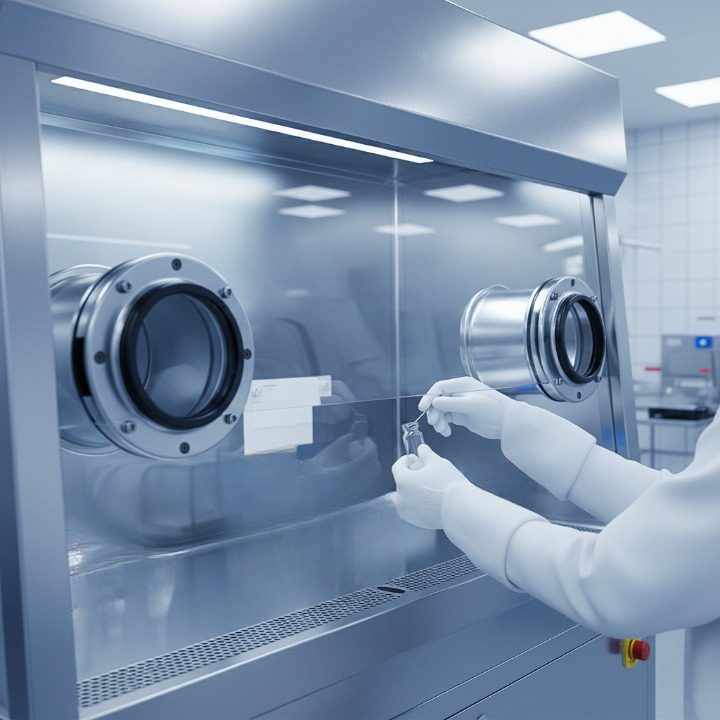
8 Critical Parameters for Airtight Seal Design in Pharmaceutical Isolators
Because nothing ruins an engineer’s day faster than a pressure test failure.
Let’s be honest: in pharmaceutical manufacturing, isolators are treated like royalty. Everyone pays attention to the big stainless-steel box, the touchscreen panel, the fancy glove ports …… but the seal?
The poor thing sits quietly in the corner, doing all the heavy lifting while getting absolutely zero appreciation.
Until the day- yes, that dreaded day when the pressure hold test fails.
Suddenly, that “simple” strip of elastomer becomes the most important thing in the entire plant.
If isolators could talk, they’d say:
“You only love me when I leak.”
So let’s give seals the respect they deserve. Here are the eight parameters that decide whether your isolator will run smoothly for years… or become your next shutdown meeting.
1. Airtightness: The First Test an Isolator Must Pass
A truly airtight seal doesn’t merely close a gap it creates a controlled environment that nothing can enter or escape.
Good seals maintain integrity even during pressure fluctuations, door closures, glove port movements, and repeated VHP cycles. Inflatable seals are often preferred because their expansion creates a uniform, gas-tight barrier every single time.
Without airtightness, everything else falls apart.
2. Material Compatibility: Not Every Elastomer Survives Pharma Conditions
Isolators operate in a harsh chemical world: hydrogen peroxide vapor, alcohols, cleaning agents, and sterilization cycles that repeat endlessly.
A seal must not swell, crack, or react with any of these.
Materials like platinum-cured silicone, EPDM, or FKM, are chosen because they’re stable, biocompatible, and refuse to shed particles, a non-negotiable requirement in sterile manufacturing.
A seal that interacts chemically with the environment is a contamination risk waiting to happen.
3. Durability: Can the Seal Survive 500+ Decontamination Cycles?
Pharmaceutical isolators aren’t occasional-use machines. Some run 24/7 for years, cycling between operation and decontamination. A durable seal maintains:
- its elasticity,
- its compression profile,
- and its shape
…without sagging or hardening.
Once a seal loses its form, microscopic leak paths open often invisible to the naked eye, but enough to fail pressure hold tests.
4. Pressure Differential Stability: Where Most Isolators Fail
Every isolator depends on stable positive or negative pressure.
If seals are not designed to hold these differentials:
- sterility breaks,
- containment fails,
- and safety risks increase.
Even a small pressure imbalance can cause microbial ingress or escape of potent compounds. A good isolator seal doesn’t only close; it supports the physics inside the isolator.
5. Cleanability: The Seal Should Never Become a Contamination Trap
A poorly designed seal will hold onto H₂O₂ droplets, dust, or residue making decontamination slower and less reliable.
Smooth surfaces and non-porous materials ensure the seal can be thoroughly cleaned and aerated quickly, which directly impacts production uptime.
In pharma, cleanability isn’t a convenience.
It’s a compliance requirement.
6. Mechanical Strength: The Door Moves Thousands of Times, the Seal Must Keep Up
Isolator doors, glove ports, and access panels all exert mechanical stress.
The seal must flex, compress, rebound, and maintain shape without tearing or deforming.
This is where inflatable seals excel they offer structure when inflated and rest when deflated, extending their lifespan significantly.
Mechanical fatigue is one of the most common reasons for premature seal failure.
7. Maintenance-Friendly Design: Engineers Shouldn’t Have to Fight the Equipment
Good seal design allows:
- quick visual inspection,
- easy removal, and
- simple replacement
…without disturbing validated conditions.
When seals are modular and easy to access, preventive maintenance becomes efficient and predictable which is exactly what pharmaceutical operations need.
8. Regulatory Compliance: The Seal Must Prove Its Integrity, Not Just Promise It
Regulators expect isolators to meet strict standards like ISO 14644, FDA, EMA, and USP Class VI.
This means seals must be validated through:
- leak testing,
- pressure decay tests,
- chemical compatibility checks,
- sterilization validation, and
- microbial ingress testing.
A compliant seal accelerates equipment qualification (IQ/OQ) and reduces risk during audits.


No comment yet, add your voice below!