
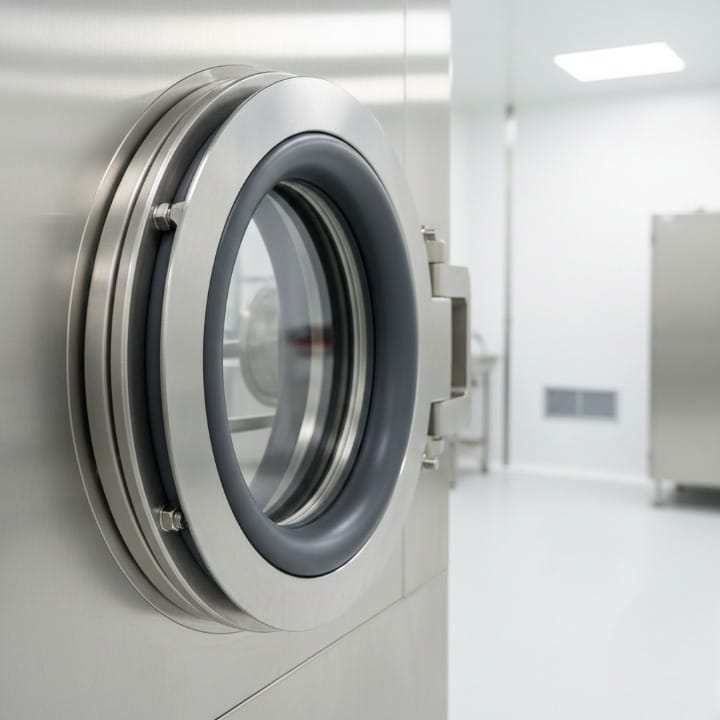
Inflatable Seals for Pharma Isolators: Leakage, Validation & Material Risks Engineers Often Overlook
Pharmaceutical isolators are built to eliminate risk. The irony? Many isolator failures start right at the seal interface.
Inflatable seals are popular in isolators because they handle misalignment, uneven surfaces, and repeated opening cycles. But in real pharma environments, isolator-related deviations, leaks, and validation delays often trace back to inflatable seal decisions made early in design.
This article covers the most overlooked risks engineers face when using inflatable seals in pharmaceutical isolators, and how to prevent them before validation or production.
Why Isolator Sealing Is Different
Isolators aren’t like standard cleanroom doors or enclosures. They operate under continuous pressure differentials, strict containment requirements, repeated decontamination cycles (VHP, SIP, autoclave), and zero tolerance for leaks.
In this context, inflatable seals aren’t just sealing components. They’re containment-critical parts. A seal that works mechanically can still fail functionally when it matters most.
The Hidden Leakage Problem
One of the most dangerous assumptions in isolator sealing is thinking that no visible leak means the seal is fine. In isolators, leakage shows up as micro-leaks under pressure fluctuation, loss of uniform contact force, or sealing gaps during inflation and deflation cycles.
Engineers commonly overlook things like uneven inflation due to long seal lengths, pressure drop across the seal profile, inconsistent groove depth around the isolator frame, and seal stretching during installation. These issues often don’t appear during installation. They show up later during pressure decay tests, containment verification, or media fill simulations.
When Validation Stalls
Isolator validation demands repeatability. A frequent validation red flag happens when the seal profile changes without documentation, groove dimensions get modified during assembly, or inflation pressure is adjusted to “fix” leakage.
From a validation standpoint, this creates real uncertainty. Which configuration was actually validated? Which pressure condition is approved? Which drawing represents the tested state? If these answers aren’t crystal clear, OQ or PQ stalls even if the isolator performs well.
Material Selection Goes Deeper Than Labels
Most isolator inflatable seals are specified as silicone, platinum-cured silicone, or occasionally EPDM. But isolator environments impose specific stresses: exposure to VHP or sterilants, repeated thermal cycling, and long static dwell times under compression.
Common material risks include silicone hardening after repeated decontamination, compression set reducing sealing force over time, surface micro-cracking that’s invisible during inspection, and extractables and leachables data that doesn’t align to isolator process media.
Auditors don’t ask “Is the material compliant?” They ask “Is this material suitable for this isolator process?” That’s a much harder question to answer without the right documentation.
The Over-Inflation Trap
In isolators, over-inflation often becomes a quick fix to compensate for frame misalignment, overcome surface irregularities, or improve contact pressure. While this might temporarily stop leaks, it introduces excessive tensile stress in the seal, accelerated fatigue, and unpredictable deflation behavior.
Over time, this leads to seal bulging, slow leaks, and inconsistent sealing across cycles. From a validation perspective, uncontrolled inflation pressure is a major compliance risk.
Sterilization's Gradual Impact
Isolator seals rarely fail suddenly. Instead, performance degrades slowly from repeated VHP exposure, thermal expansion and contraction, and long-term compression under pressure.
Without cycle-based testing data that reflects actual isolator conditions, realistic cycle counts, and pressure-temperature combinations, engineers are left guessing when seal replacement becomes necessary. Validation teams require defined limits, not assumptions.
Traceability in Isolators
In isolator applications, traceability isn’t optional. Typical audit questions include: Can you trace this seal to a compound batch? What happens if the formulation changes? How are dimensional changes controlled? How do you ensure replacement seals match validated ones?
If inflatable seals are treated as consumables rather than validated components, confidence erodes quickly during inspections.
Reducing Isolator Sealing Risk
Best practices that consistently prevent isolator-related seal issues start with locking seal profile and groove design together early. Define inflation pressure limits, not just operating pressure. Validate seal performance across sterilization cycles. Ensure material compliance is process-specific. Maintain traceability from compound to finished seal. Document changes, even the ones that seem minor.
In isolators, small sealing decisions carry large regulatory consequences.
The Bottom Line
Inflatable seals work exceptionally well in pharmaceutical isolators, but only when treated as critical containment components rather than flexible accessories. When design, material, pressure, and documentation align, isolator validation becomes predictable instead of reactive.
And in pharma, predictability is the real measure of reliability.

No comment yet, add your voice below!