
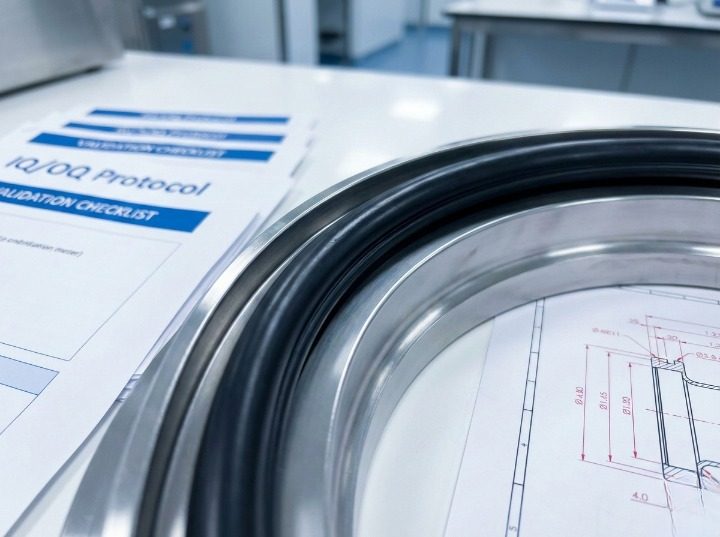
Why Inflatable Seals Fail Pharmaceutical Validation (And How Engineers Can Prevent It)
Here’s something that catches a lot of engineers off guard: in pharmaceutical equipment, seal failures rarely start at the seal itself. They start during validation.
You might have an inflatable seal that inflates perfectly, passes every pressure test, and comes with all the right compliance labels. But then IQ, OQ, or PQ fails anyway. When this happens, the real problem is usually somewhere else entirely.
It's Not About the Seal It's About the System
Most validation failures aren’t what you’d expect. They’re not from visible damage, obvious leaks, or even wrong material choices. The issue is simpler and more frustrating: validation requires proof, not just performance.
In regulated pharma, nobody’s asking “Does the seal work?” They’re asking “Can you prove it works consistently, with full traceability, under these specific conditions?” That subtle difference is where things fall apart.
Where Validation Actually Goes Wrong
The Material Looks Compliant But Is It Really?

Let’s say your seal material is USP Class VI certified. That should be enough, right? Not quite. Auditors don’t validate materials in a vacuum. They validate materials in actual use.
The problem shows up when you have USP Class VI data for the raw compound but not the finished seal. Or when FDA compliance statements don’t mention your specific temperature range or contact media. Sometimes there’s no clear connection between the extractables and leachables data and what’s actually happening in your process. And if you can’t trace the compound batch to the seal you received, that’s another red flag.
Material compliance needs to connect directly to your equipment, your operating temperature, your sterilization method, and what the seal contacts. Without that context, validation teams start asking uncomfortable questions.
Documentation That's All Over the Place

This one kills more validations than almost anything else. During audits, you’ll be asked for dimensional specs, installation orientation, inflation pressure limits, and expected cycle life. If that information lives in emails, scattered drawings, various test reports, and supplier brochures, you’re in trouble.
Maybe there’s no single approved drawing for the seal profile. Maybe inflation pressure is listed as a range instead of a validated limit. Maybe cycle testing data exists but isn’t linked to your specific part number. Or there’s no revision control on any of it.
Validation doesn’t fail because you’re missing data. It fails because your data tells different stories depending on where you look.
Design Decisions That Made Sense at the Time

Inflatable seals are pretty forgiving, which can work against you. Small adjustments that solve immediate problems create validation headaches later.
Someone adjusts the groove depth to make the seal fit better. There’s slight gap variation across the door frame. Inflation pressure gets bumped up to compensate for misalignment. The seal ends up compressed more than originally intended.
These fixes work in the moment, but they come back to haunt you during validation. Over-compression wears out the material faster. Uneven inflation means inconsistent sealing force. Stress concentrations cut down cycle life.
Then an auditor asks: “Was this groove designed for this seal from the start, or was it adapted later?” If you hesitate, validation grinds to a halt.
What Sterilization Does Over Time

Plenty of inflatable seals ace their initial tests and then fail after they’ve been through multiple SIP or autoclave cycles. Validation isn’t just about day-one performance—it’s about proving the seal will hold up over its entire service life.
The seal might develop compression set after steam exposure. The material could harden from thermal cycling. Micro-cracks that you can’t see with your eyes start forming. The way the seal responds to inflation pressure changes after repeated sterilization.
Without documented cycle testing that matches your actual sterilization parameters, expected number of cycles, and pressure-temperature combinations, there’s no way to demonstrate long-term reliability.
When Traceability Falls Apart

In pharma validation, traceability equals control. If you can’t trace it, you can’t defend it.
Common problems: seals arrive without batch identification, material certificates that don’t link to production lots, no record of which compound formulation was used, no change history when the design gets modified.
Even if the seal performs flawlessly, poor traceability raises a fundamental question: “If something changes down the line, how will you even know?” Validation teams need a solid answer.
How to Prevent These Failures
The good news? Validation failures are almost always preventable. You just need discipline early in the process.
Start by defining seal requirements before you source anything, not after something fails. Lock in your groove design and seal profile together as a matched set. Validate inflation pressure limits, not just your normal operating pressure. Get all documentation as a single controlled reference, not scattered across multiple sources. Make sure material compliance is directly relevant to your actual process. Confirm full traceability from raw compound all the way to the finished seal.
Most importantly, treat inflatable seals as critical validation components. They’re not just another consumable.
The Bottom Line
Inflatable seals don’t fail pharmaceutical validation because they’re unreliable. They fail when assumptions replace documentation, when performance claims replace actual proof, and when responsibility gets divided across too many teams.
Work from a single shared reference, and validation becomes something you can predict, repeat, and defend. That’s exactly what regulated environments demand and exactly what successful projects deliver.


No comment yet, add your voice below!